The Story
A Jeep is like crossing a tiger with a parrot: hard to say exactly what you’ve got, but when it speaks, you listen.
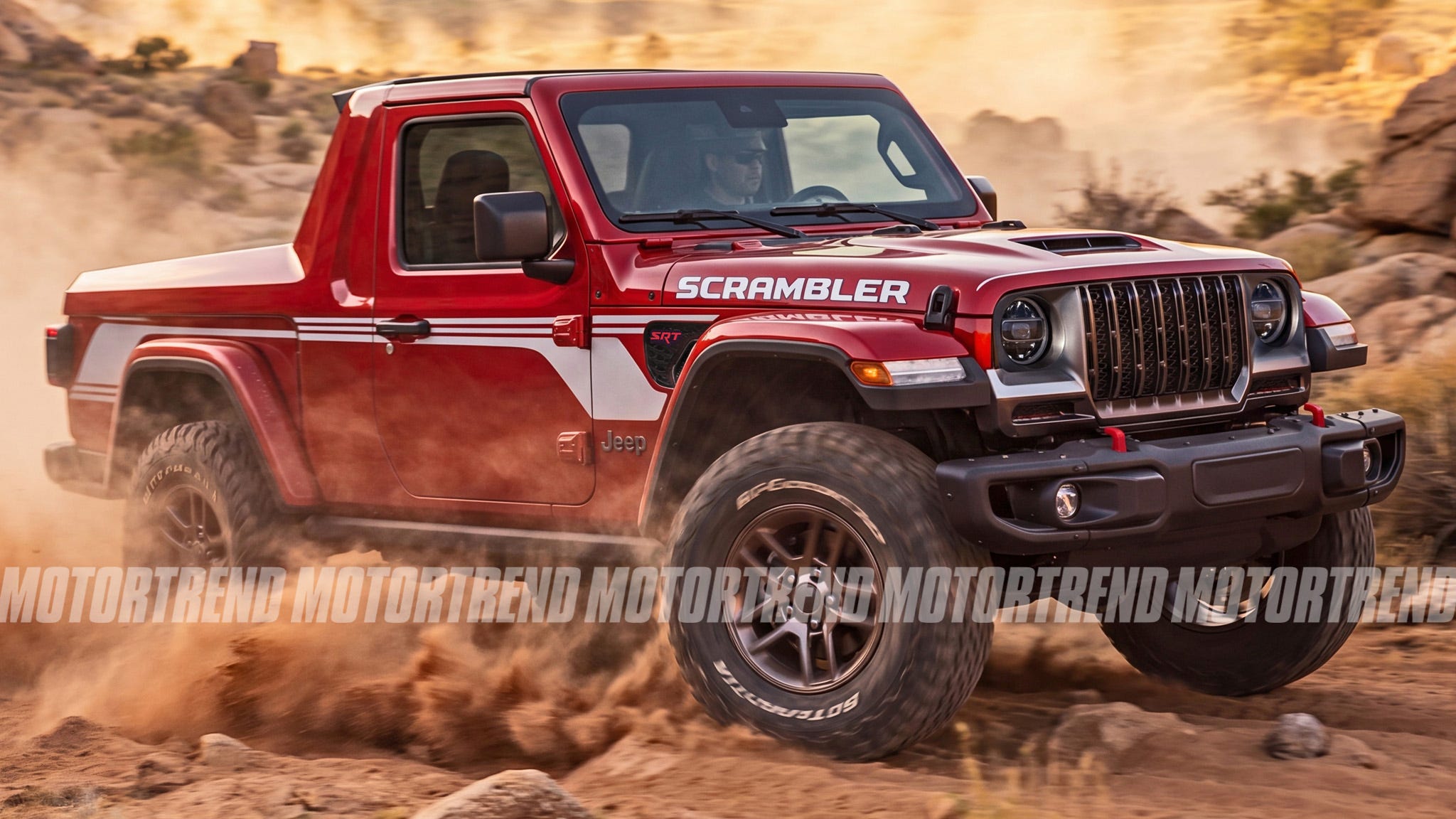
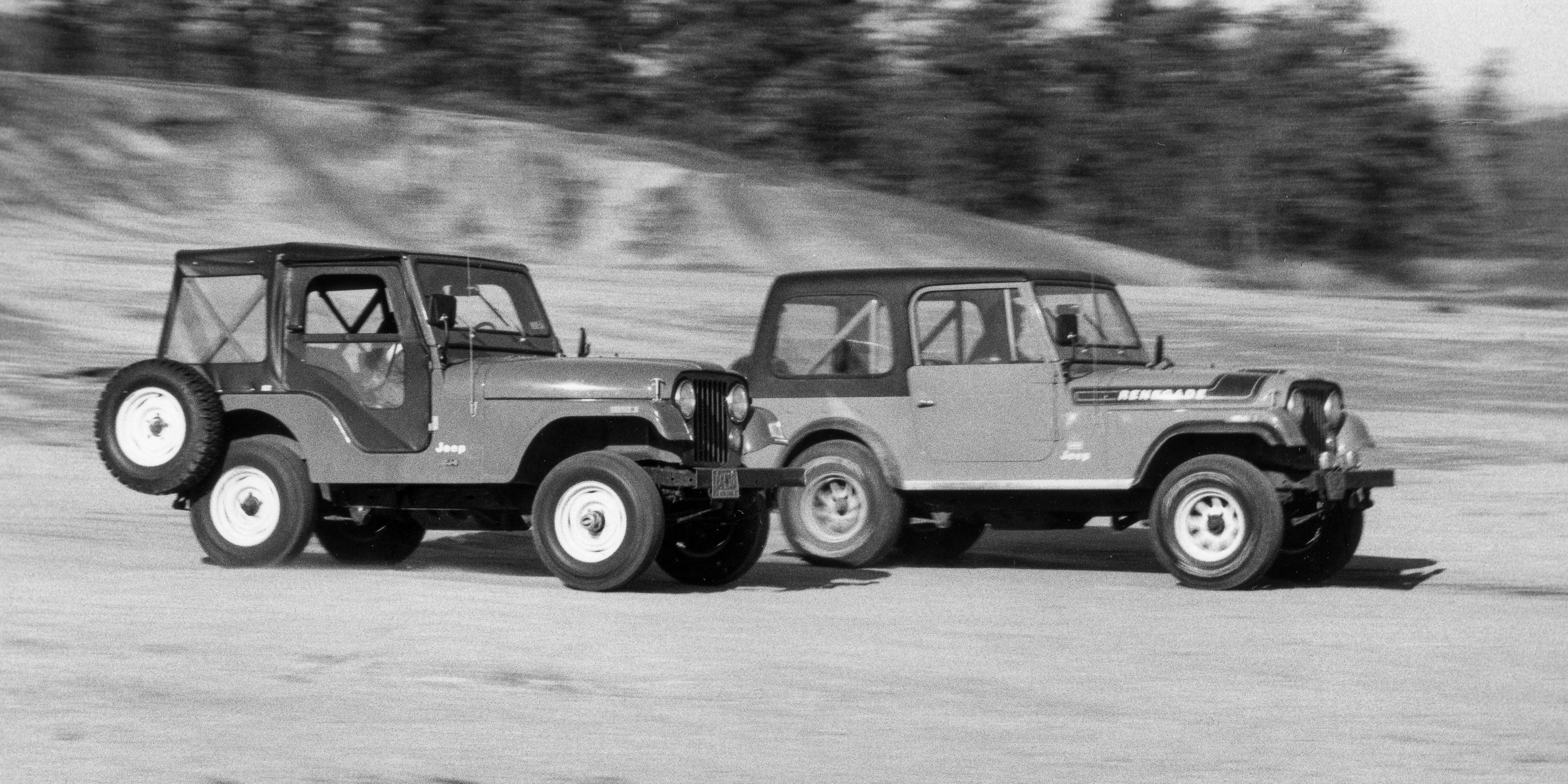
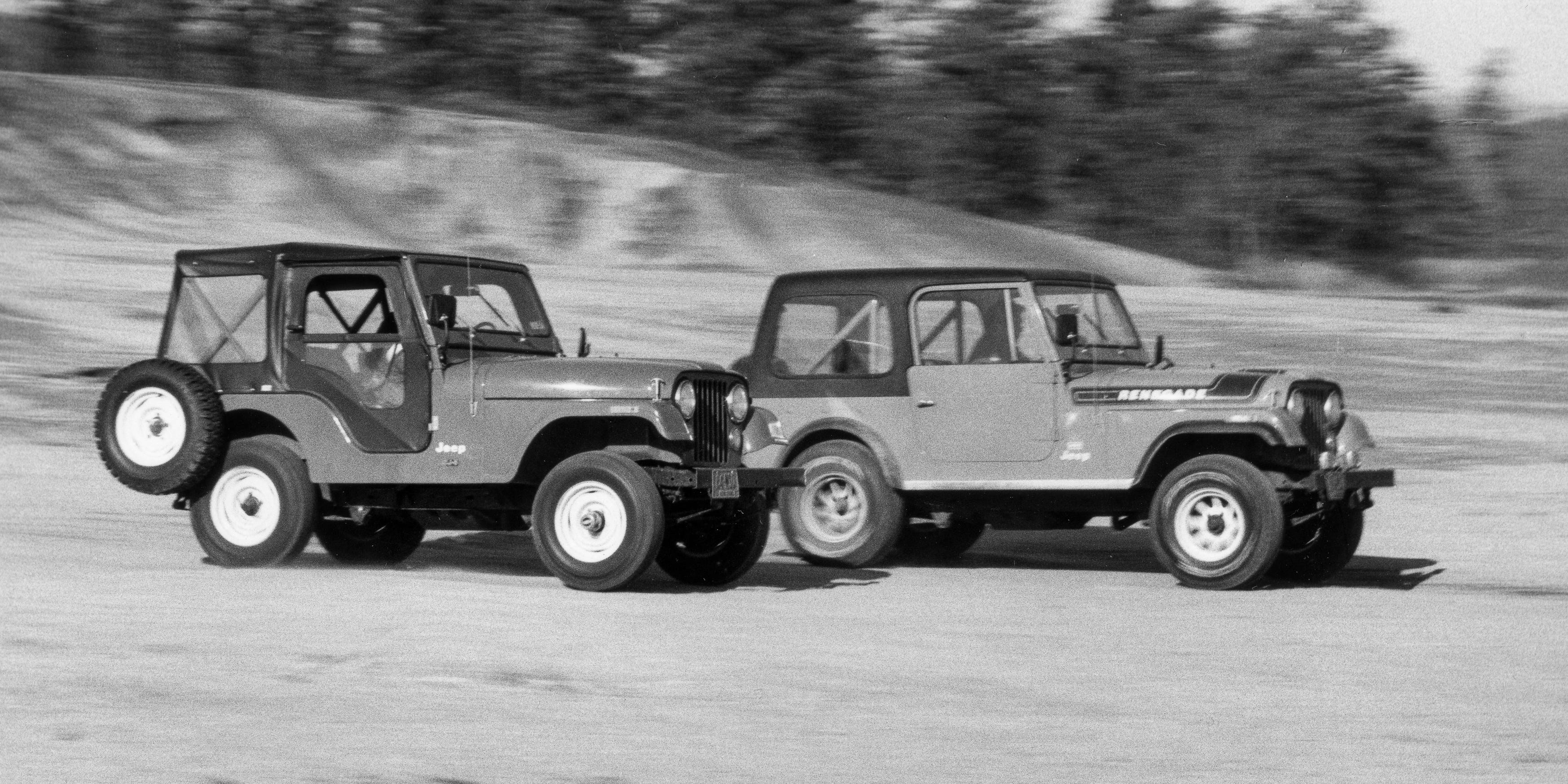
| View PhotosNoel Werrett | Car and DriverFrom the June 1976 issue of Car and Driver. Use at Own Risk said the bullet-riddled sign at the edge of what appeared to be a firebreak through the dense brush. The search for this parcel of scrub-pine forest had begun at sunrise. As we stopped a pair of somewhat unusual C/D test vehicles—a 1976 Jeep CJ-7 Renegade and Jeep CJ-5—we were hopeful that our dawn patrol had not been a waste of time. After all, this was going to be the payoff, like taking a Turbo Carrera for a couple of hot laps at Lime Rock or aiming a hemi Road Runner down through the lights at New York National. We were about to enter the proper environment in which to test the capabilities of our two Jeeps. |
The CJ-5 could be considered the purist amid today’s growing crowd of four-wheel-drive vehicles, much as the MG has held on for a quarter of a century in the face of innumerable variations on the sports-car theme. The CJ-5’s short wheelbase (83.5 inches) paved the way for a sports/utility 4WD category that now offers wheelbases up to two feet longer. GMC’s Jimmy, Chevy’s Blazer, the Dodge Ramcharger and Plymouth Trailblazer as well as the Jeep Wagoneer and Cherokee are all within three inches of one another, and all can be tailored to a variety of applications. Ford Bronco and Toyota Land Cruiser fall into the CJ-5/7 segment (94 inches and shorter). Which leaves the International Scout somewhere in the middle (100 inches), exactly where International’s marketers apparently want it. Summed up, it depends just how tough the terrain you regularly traverse really is—and just how serious you are.
An element common to all enthusiast automobiles is that they embody a purpose and prowess that is outside the realm of everyday transportation. They also have qualities that are almost always implied by appearance, tested only under special circumstances and demanding of a certain degree of tolerance when the car is used as mere transportation. A traditionalist might not accept a Jeep as a piece of enthusiast’s hardware, but it certainly meets those basic criteria. Its tall, narrow body and rudimentary styling set a CJ apart from just about everything on the road; and even to the most casual observer, the CJ’s live axles, Conestoga-wagon suspension, rollbar and multiple shift levers suggest something other than boulevard and Interstate travel. As for practicality . . Well, after two days of driving this pair of Jeeps around, we already were calling the Spartan little CJ-5 “the Penalty Box.”.
Initially, the CJ-5 was considered the more desirable to drive because it was quick. Though both our test vehicles were equipped with identical 304-cubic inch two-barrel V-8s, the -5’s standard three-speed manual transmission allowed it to come away from signal lights like a little red bear, leaving assorted sedans and sports cars slack-jawed. At New York National, it turned the quarter-mile in just a tick under 17 seconds and almost 80 mph, which is a performance worthy of today’s crop of “performance cars” and both quicker and faster than a Porsche 912E.
The heavier automatic-transmission CJ-7 was about a second and a half and seven mph slower in the quarter, but although the novelty of the CJ-5’s acceleration never really wore off, the relative civility of the -7 soon made it the plum. This is not to say the CJ-7 is any Sevllle, for things like sound insulation and suspension isolation obviously are not prime concerns of AMC-Jeep engineers. Engine, drivetrain and road noise came through the uncarpeted floor (and our CJ-7 was equipped with the $869 Renegade trim package) as if it were a speaker cone and reverberated through the hard-edged interior. It produced a constant song-of-the-road background score as one traveled along, seated bolt upright, towering an awkward two feet above the majority of fellow motorists. But the body and optional fiberglass hardtop of our CJ-7 were remarkably tight and rattle-free. In a CJ Jeep, you’re constantly reminded of its toughness, the heavy-handed use of exposed hexhead bolts and blacksmith-simple angular fittings assuring you that nothing is going to fall off.
While the basic body of the CJ-5 is undoubtedly as solid as the -7’s, neither a hardtop nor solid doors are available from AMC for the CJ-5. The “optional” (a top of any description costs extra on both the CJ-5 and -7) soft top and vinyl doors on our CJ fluttered and rattled so heartily that it was impossible to hear creaks, rattles, the radio or even the heater, which roars like a departing 747. Under full-throttle acceleration, the CJ-5 came close to pegging our sound-level meter—recording 96 dBA, which is well into the discomfort zone. Under the same conditions, the hard-topped CJ-7 peaked at 86 dBA. But on the highway, it was more than just its assault on the driver’s eardrums that earned the CJ-5 its nickname.
Outwardly, the CJ-7 appears to be simply a -5 stretched 10 inches. Technically, it would be more accurate to describe the 1976 version of the venerable CJ-5 as a CJ-7 with 10 inches chopped out of the middle. A rugged new wide-rail box frame designed for the CJ-7 is now common to both vehicles, the only major difference being length. A longer chassis was necessary to accommodate AMC’s Turbo-Hydramatic/Quadra-Trac unit, which became available for the first time in a CJ model with the creation of the CJ-7. Previously, this combination automatic transmission and full-time four-wheel-drive system was offered only in AMC’s Wagoneer/Cherokee station wagons and Jeep pickups; the CJ-5 chassis was, and still is, too short to accommodate it. The extra beef in the new chassis provides torsional rigidity and strength to compensate for the added length and weight of the -7. Fully dressed, with hardtop, doors, Renegade trim and automatic transmission/Quadra-Trac, our test CJ-7 outweighed our -5 by 635 pounds (3835 versus 3200).
It doesn’t take an engineer to understand that sawing more than 10 percent out of a vehicle’s wheelbase and lightening it by more than 15 percent will produce some dramatic changes. Compared to our CJ-7—even though it was equipped with the optional heavy-duty suspension package—the pavement ride of our standard-suspension CJ-5 was just plain harsh. In the -5, every negative characteristic of the -7 seems amplified. Its lighter weight and abbreviated length conspire to give the little Jeep a far choppier, generally less stable ride than that of the big one.
Subjectively, the only plus that our CJ-5 exhibited over the -7 on the highway was in the way it steered. The -7 was equipped with power steering, which on CJ models is a constant-rate system with a ratio of 17.5 to one (3.6 turns lock-to-lock). That might not sound superfast, but to keep the CJ-7 going straight down a crowded expressway took a gentle hand to keep from over-correcting for wind wander, bump steer and vagaries induced by the giant off-road tires that it was wearing.
Considering the extra weight of a fully equipped CJ-7, it might seem that power steering is a must. However, the effort required on our manual-steering CJ-5 was extremely low, thanks to the mechanical advantage of the much slower 24-to-one ratio. This translates to one extra turn lock-to-lock and makes the CJ-5 a lot less twitchy.
Meanwhile, back at our patch of scrub-pine forest, we were about to discover some of the most important attributes of our Jeeps. Since the CJ-7 was equipped with Quadra-Trac, there was no need for it to stop or shift before plunging off the pavement into the rough stuff. The CJ-5’s two-speed Spicer transfer case needed to be shifted manually into four-wheel drive, but this also could be done without stopping since the selective front hubs were already set in the “lock” position. (Turned to the “free” position, they eliminate the rotation of the front-drive components—axles, differential and propeller shaft—that normally would continue even when the vehicle is being operated in two-wheel drive. This reduces unnecessary wear on the entire train of front-drive parts and also makes steering a lot easier.).
As simple and as painless as this shift is, the novice Jeep driver will undoubtedly find themself bracing for the worst the first time they aim a CJ-5 off the road and into the woods. But what should follow is a pleasant surprise.
Why It Matters
The heavier automatic-transmission CJ-7 was about a second and a half and seven mph slower in the quarter, but although the novelty of the CJ-5’s acceleration never really wore off, the relative civility of the -7 soon made it the plum.
CarMotion Daily’s Take
A traditionalist might not accept a Jeep as a piece of enthusiast’s hardware, but it certainly meets those basic criteria. Watch this space over the coming weeks.
📝 Source & Copyright Notice
This story was first reported by CarAndDriver. For the full article with original photography and complete coverage, visit the source: Read the full story at CarAndDriver →