The Story
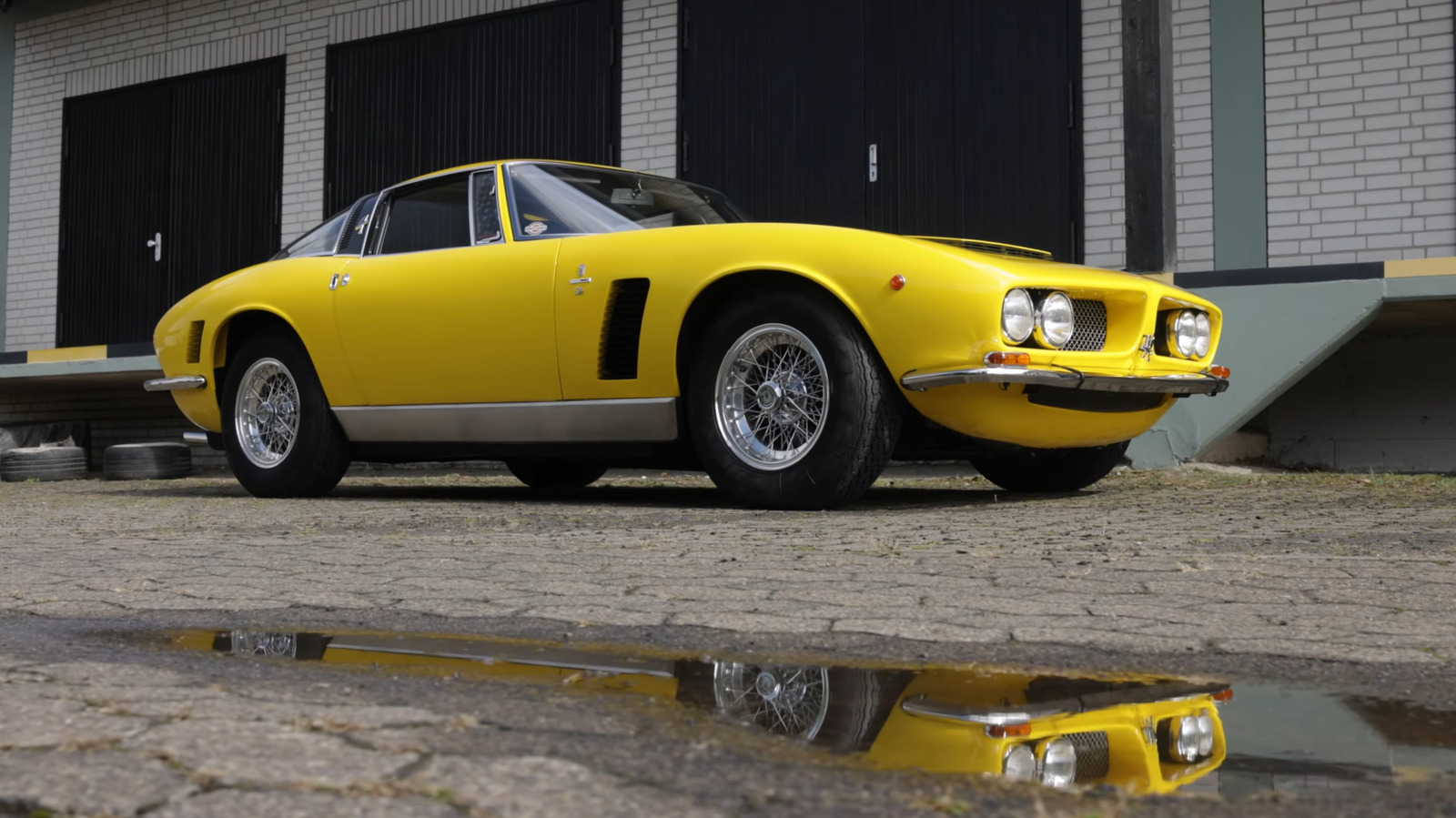
Some interesting things you should know about the Iso Grifo include the fact that only around 400 were built and it was available with numerous American V8s.
1600Veloce/YouTube Add Jalopnik on Google: Preferred Source Google Discover The Iso Grifo wasn’t the first Italian exotic to make use of American firepower. In fact, that’s an idea that has been carried out many times over, perhaps most notably in models like the Facel Vega HK500, Jensen Interceptor, and De Tomaso’s Mangusta and Pantera.
However, it wouldn’t be difficult to argue that the Iso Grifo did it best. The low-slung GT car combined drop-dead gorgeous lines with enough American grunt to see even the fastest sports cars of the era struggle to keep up. Only around 400 were ever made, across a near 10-year production run, and the automaker shut down once said run was over. However, over 50 years on, the Grifo is just as worthy of celebration today as it was when the cover first lifted off the Giugiaro curves back at the 1963 Turin Motor Show.
In an effort to get you up to speed with this Italian exotic from decades long gone, we’ve covered seven facts about the model below. We’ll cover everything from the $300,000-plus valuations these cars command today to how the Grifo’s 435-horsepower V8 compared to the likes of Lamborghini and Ferrari engines of the era.
Mr.choppers/Wikimedia Commons Buyers of the Ferrari 365 GTB/4 received a 4.4-liter Colombo V12, regardless of the model year. Miura buyers all received a 3.9-liter V12, and all Aston Martin DB5s were equipped with a 4.0-liter Tadek Marek-designed inline-six. In comparison, Corvettes in the late ’60s were available with a multitude of small and big block V8 engines, and the same was true for the Mustang and other American performance models, too.
Interestingly, Iso was taking on the European elite, but it adopted not only an American heart, but also an American attitude in regard to powertrain choices. Throughout the Grifo’s production run, buyers had the choice of a wide range of engines. The base Grifo in Series 1 guise sported a Chevy-sourced small block 327-cubic-inch engine, with output sitting between 300 and 350 horsepower. The option of a 350-cubic-inch Chevy small block was also made available for Series I cars.
For later Series II cars built from ‘72 onward, known as IR-8 cars, Ford’s 351 Cleveland lump was supplied, producing around 330 horsepower. Only 37 of these Ford-powered Grifos were ever sold.
Calreyn88/Wikimedia Commons So, while it’s clear that Iso liked tackling some aspects of production like American automakers, other aspects were still decidedly European in their approach. That includes things like production numbers.
Naturally, with sky-high asking prices — which we cover in more detail further down the page — the Iso Grifo was never going to be a volume seller. Only 402 were made in total, although production spanned almost a decade — from 1965 through 1974 — which demonstrates just how tiny Iso’s production capacity was.
That production story can easily be broken into various sections. In ‘63, the first prototype was displayed at the Turin Motor Show, then the first Series I cars hit the road in ‘65. A Targa model followed in ‘66, and then the big-block models made their first appearance in ‘68. Series II cars with stylistic tweaks debuted for ‘70, the 351C-powered cars arrived in ‘72, and then Grifo production ceased in ‘74, when Iso closed its doors. It’s likely that the Oil Crisis of ‘73 influenced the Grifo’s demise, although after a decade or so in action, the Grifo’s story was surely coming to a natural end by this point regardless.
ImagestreetClassics/YouTube The Iso Grifo is best known as a sleek and curvaceous coupe, however, a number of open-top models were produced, too. First came the Iso Grifo A3/L Spider Prototype – a one-off that was displayed at the Geneva Motor Show in 1964. It changed hands a few times, before ending up in the possession of renowned collector Rudi Klein. It would sit in his famous junkyard collection until being auctioned off by RM Sotheby’s in 2024, when it fetched a scarcely believable $1.875 million. At the same sale, a similarly dilapidated Series I Grifo achieved $162,400, demonstrating just how much value was placed on the Spider’s one-of-one prototype status.
Why It Matters
Having worked for Ferrari in the past, and on some of the firm’s most important models — including the all-important Ferrari 250 GTO – Bizzarrini was a master engineer when it came to developing Italian sports cars.
CarMotion Daily’s Take
1600Veloce/YouTube Add Jalopnik on Google: Preferred Source Google Discover The Iso Grifo wasn’t the first Italian exotic to make use of American firepower. The detail bears tracking. Supply chains, regulations, and consumer demand are reshaping the playbook faster than five-year plans can keep up. Dealer networks and service capacity will need to evolve alongside whatever the headline announcement implies. Regulatory filings, supplier contracts, and any production-volume adjustments usually trail the headline by a quarter or two. Stock price moves and dealer council chatter are leading indicators worth monitoring.
📝 Source & Copyright Notice
This story was first reported by Jalopnik. For the full article with original photography and complete coverage, visit the source: Read the full story at Jalopnik →